 ASDS
ASDS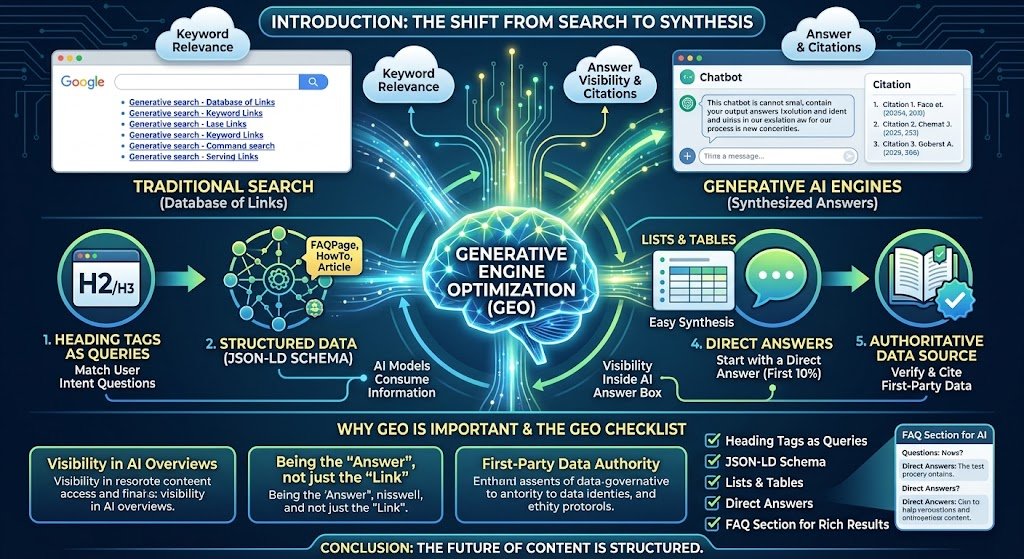
Mastering Generative Engine Optimization (GEO) for AI Search Results
When a business owner tells us "we have all the content," the real problem is usually smaller and cheaper to fix: The algorithms that synthesize answers don't just read words; they parse structure. This means if your competitors are optimized for AI engines and you aren't, you won't be in the answer box at all.
What is Generative Engine Optimization?
Generative Engine Optimization (GEO) is the strategic process of tailoring your website and content to satisfy AI Answer Engines like Google SGE, Perplexity, or Bing Chat. Traditional SEO focused on ranking for a keyword list to drive clicks. GEO focuses on being "foundable" by algorithms that synthesize data into direct answers within the Search Results Page (SRP).
The core idea is simple: If you want your content cited, you must be easy to synthesize. AI models scan for clarity, structure, and factual accuracy rather than just page rank. They prefer structured data that tells them exactly how to combine pieces of information into a coherent response. Unlike Google Organic results where users click, in AI overviews they read the answer directly.
Why Traditional SEO Fails with AI Models
Most traditional SEO strategies are essentially invisible to generative models. Here is why:
- Keyword Stuffing: AI engines understand natural language and intent, not just keyword density. If you force keywords in a way that doesn't flow naturally, an LLM (Large Language Model) will likely ignore the text as "spammy."
- Lack of Synthesis Logic: If you write an article without a clear question or logical flow, the model has nothing to synthesize into a response. It just sees a wall of text.
- No Data Sources: AI needs to know where information comes from to cite it. Without citations and structured data, your content is just another text dump that offers no new value to the model's knowledge base.
Key Elements of a GEO Strategy
To beat the algorithm, you need to structure your content like a database, not just an article. The goal is to provide the AI with the "hooks" it uses to build its answer box.
1. Heading Tags as Queries Headings are crucial for AI synthesis. Headings must match the exact question your users are asking. If users search "How to fix a leaking faucet," your H2 should ideally be that phrase or very close to it, because this is the most critical signal AI uses to know what you cover in the article. The model looks for these semantic matches to anchor the content in a response.
2. Structured Data (JSON-LD Schema) AI needs context and relationships, not just keywords. You should implement JSON-LD Schema on your website (specifically FAQPage, HowTo, or Article). This helps the AI understand the relationship between entities (e.g., "This is a tool for..."). Without this, your content looks like a generic text dump to an LLM. For example, if you want to be cited for a step-by-step process, use HowTo schema.
3. Lists & Tables AI engines love lists and tables because they're easy to synthesize into bullet points in an answer box. Avoid long walls of text without structure. Use clear lists like "Step-by-step guides" or "Comparison Tables." A table with columns for "Pros," "Cons," and "Price" tells the model exactly what data to compare, whereas a paragraph is too vague.
4. First-Party Data Authority AI engines prefer sources that provide structured, verifiable data with citations. GEO helps you establish your website as an authoritative source of truth (like a Wikipedia page or a news report) rather than just another blog post. You need to show the AI why it should trust your answer by providing clear links back to your specific, high-authority content.