ASDS
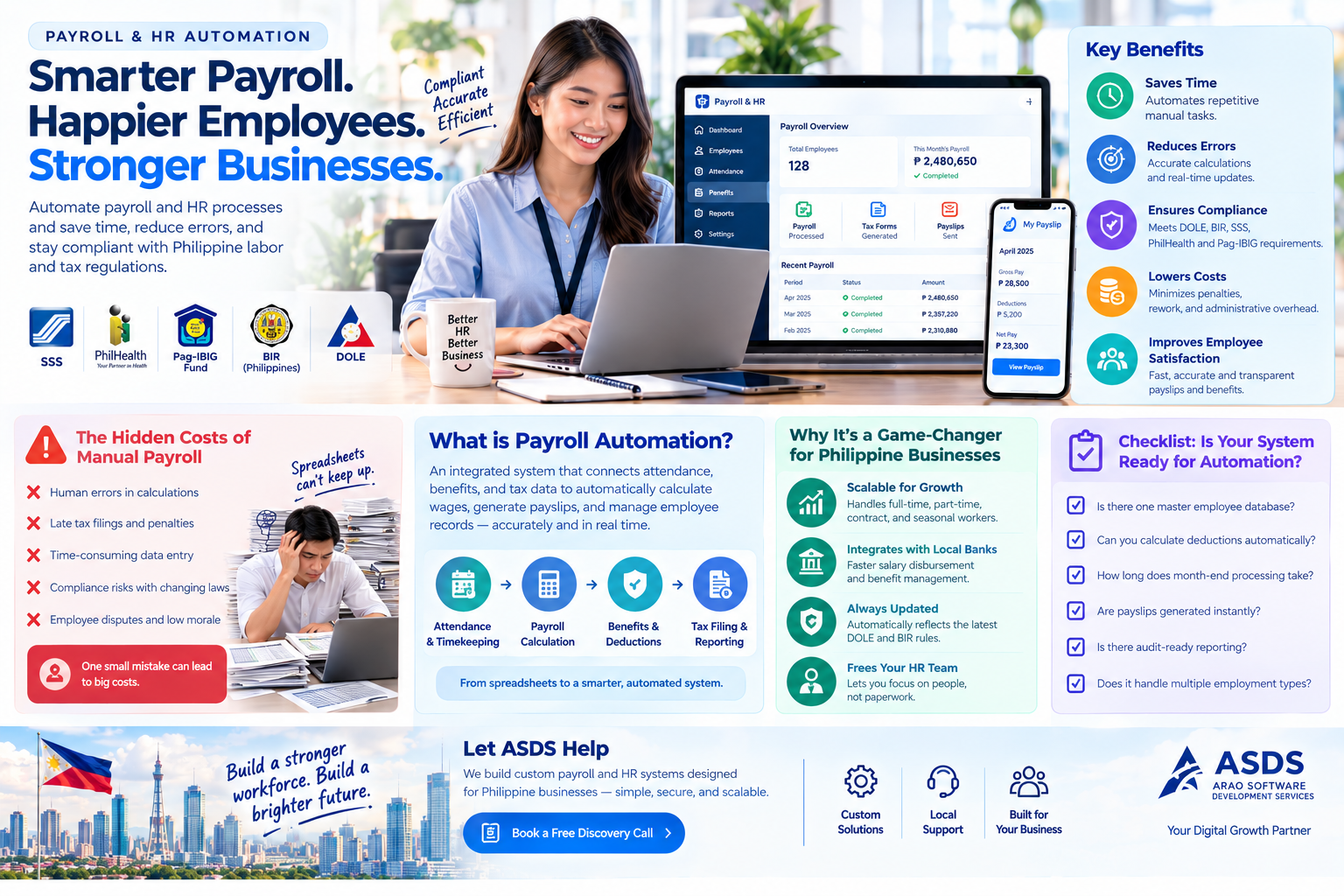
Many Philippine businesses are automating payroll and HR because manual processing is prone to costly errors, consumes excessive hours, and creates compliance risks that AI-driven automation can eliminate. Payroll automation refers to using software systems to calculate wages, manage benefits, generate tax documents, and handle employee records with speed and accuracy, replacing outdated spreadsheets and paper-based ledgers.
The Hidden Costs of Manual Payroll in the Philippines
Manual payroll processing is no longer just about saving time; it is a critical business risk that accumulates hidden costs through human error, administrative delays, and compliance headaches that can cripple an SME's cash flow. In the Philippine context, where labor laws are complex and strictly enforced by the Department of Labor and Employment (DOLE), relying on manual calculations invites miscalculations in deductions like SSS, PhilHealth, Pag-IBIG, and BIR taxes, which can lead to fines or employee disputes that drain resources.
The primary driver for automation is the sheer volume of repetitive data entry required to process hundreds of employees monthly, a task that traditionally consumes weeks of an HR manager's time and leaves little room for strategic planning. When businesses in Metro Manila continue to use spreadsheets to track attendance, compute overtime, and manage bonuses, they risk missing deadlines for tax filings or failing to account for recent legal changes in the Labor Code, creating a fragile operational foundation.
What Payroll Automation Actually Is
Payroll automation is not simply a fancy calculator; it is an integrated system that connects attendance data, employee profiles, benefits plans, and tax tables to generate accurate pay slips and compliance documents automatically. At its core, this technology acts as a digital double-checker that ensures every peso calculated for wages, bonuses, or deductions matches the latest Philippine government regulations without human intervention.
For a typical Filipino business owner, payroll automation means shifting from being a data entry clerk who constantly worries about typos to a strategic partner who can focus on workforce planning and employee engagement. It transforms the chaotic month-end close into a streamlined process where salaries are processed instantly, tax forms are pre-filled correctly, and employees receive their payslips via mobile apps or email within hours of payday.
The Specific Risks of Manual Processing in PH
The most immediate danger of manual payroll is the human error that leads to underpayment or overpayment, both of which erode trust between management and staff in a culture where loyalty is highly valued. Even a small calculation mistake on an overtime rate or a misapplied deduction can result in an employee feeling wronged, leading to low morale, reduced productivity, and potential labor arbitration cases that are expensive to resolve.
Beyond financial inaccuracies, manual systems create severe compliance risks because they often fail to update instantly when laws change, such as new tax brackets or mandatory benefit contributions mandated by the government. A business in Quezon City or any other region might calculate SSS contributions based on outdated rates, resulting in underpayment penalties that accumulate over months and years.
How Automation Solves Philippine Business Pain Points
Automation solves these issues by creating a single source of truth where every employee record is updated in real-time, ensuring that the system always reflects current attendance, leave balances, and contract terms automatically. This eliminates the "version control" nightmare of spreadsheets where different sheets contain conflicting data, ensuring that the final payroll number is derived from one accurate dataset rather than multiple manual inputs.
For Philippine SMEs specifically, automation provides a scalable solution that grows with the business, handling everything from full-time staff to temporary contractors and part-timers without needing to hire additional administrative support during peak seasons. It also integrates seamlessly with local payment gateways and banking systems, allowing for faster disbursement of salaries and easier management of employee loans or other benefits common in the region.
A Simple Checklist to Evaluate Your Current System
Before investing in a new solution, businesses should assess their current processes against this checklist to identify exactly where manual inefficiencies are costing them money and time every month. This self-audit helps determine if your existing tools can be tweaked or if a full system overhaul is necessary for long-term stability and growth.
- Is there one master employee database? Check if all data lives in one place or scattered across multiple Excel files and paper logs.
- Can you calculate deductions automatically? Verify if the system pulls tax rates and contribution amounts directly from official government databases rather than manual entry.
- How long does month-end processing take? Measure the actual hours spent on payroll each cycle to see if it is manageable or a bottleneck.
- Are payslips generated instantly? Determine if employees receive their documents immediately after calculation or days/weeks later via email or app.
- Is there audit-ready reporting? Ensure you can generate instant reports for BIR, DOLE, and internal management without compiling data manually.
- Does it handle multiple employment types? Confirm the system manages full-time, part-time, contract, and commission-based workers accurately in one interface.
How ASDS Can Help
ASDS specializes in building custom business systems tailored specifically to the unique operational needs of Philippine companies, transforming your payroll into a reliable, automated engine that frees your HR team from repetitive tasks. If you are ready to stop worrying about calculation errors and compliance fines, we invite you to book a free discovery call with our team to discuss how we can design a system that fits your specific business model and growth trajectory.
Key takeaways
- Manual payroll in the Philippines carries high risks of human error, legal penalties, and employee dissatisfaction due to complex tax laws.
- Payroll automation integrates attendance, benefits, and tax calculations into one accurate, real-time system to eliminate manual errors.
- The shift from spreadsheets to automated systems allows HR professionals to focus on strategy rather than data entry and reconciliation.
- Automation ensures compliance with DOLE and BIR requirements by automatically updating against the latest government regulations.
- ASDS offers custom software development services to build tailored payroll and HR solutions for businesses in Metro Manila and beyond.